
The 4 Faces of RISK Every Investor Must Understand

For most people, RISK when it comes to money simply means losing money.
When someone says, “This investment is risky,” we immediately think:
“Ohh… I may lose my money.”
But risk is a much bigger and broader concept. It is a beast with many faces.
The problem is that our minds are not naturally good at understanding probability, uncertainty and future consequences. We either become unnecessarily scared of risk or completely underestimate it.
So, in this article, I will try to explain RISK in very simple language, so that the next time you take a financial decision, you can think about what can actually go wrong.
Suppose you invest ₹10 lakh into something.
What can go wrong?
You may lose the entire ₹10 lakh.
You may lose a part of your money.
You may not receive the returns that were promised.
Your investment may give positive returns but still fail to beat inflation.
The maturity amount may not be enough to achieve the goal for which you invested.
The value of your investment may fluctuate more than you can mentally handle.
The payment may get delayed after maturity.
Redeeming the investment may involve excessive paperwork, complexity and follow-ups.
You may discover that you were scammed and that nobody exists at the other end to return your money.
Tax or regulatory rules may change, reducing your final returns.
You may eventually receive all your money but only after the opportunity or goal has already passed.
All of these are risks.
Therefore, whenever we evaluate risk, we must examine it from two angles:
How likely is this event to happen?
If it happens, how much damage will it cause?
In simple terms:
Risk = Probability of an Event × Impact if It Happens
This is not meant to be a precise mathematical formula. It is a simple framework for thinking about risk.
Once we look at risk from the perspective of probability and impact, we broadly get four situations.
Situation 1: Low Probability, Low Impact
In this situation, the event is unlikely to happen and even if it happens, the damage will be small.

For example, suppose you keep ₹20,000 in the savings account of a large bank such as SBI, HDFC Bank or ICICI Bank.
There is a very low probability that the bank will fail and your money will become unavailable. Even if something unusual happens, ₹20,000 may not permanently damage your financial life.
So both the probability and the impact are low. This is generally a manageable risk.
For risks like these, you don’t need to worry too much. There is no point spending hours trying to optimise a decision whose impact is very small.
I have seen people spend hours analysing a decision whose maximum financial impact is a few thousand rupees while ignoring much bigger risks in their health insurance, loans, career or investment portfolio.
Not every risk deserves equal attention.
The amount of energy you spend on a risk should be proportional to the damage it can cause.
Situation 2: High Probability, Low Impact
Some risk events are highly likely to happen, but their long-term impact may be small.
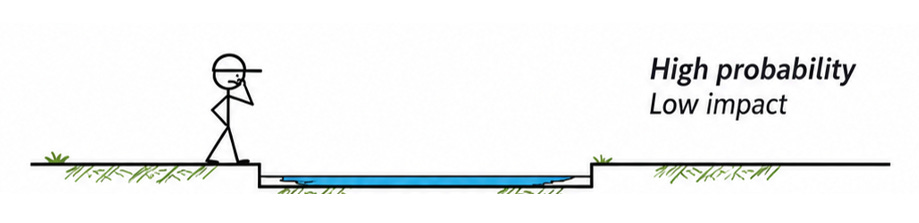
Suppose you invest in a well-diversified equity portfolio for a goal that is more than ten years away. There is a high probability that the market will correct by 10–20% at least a few times during this period.
The fall is not an unexpected accident. It is a normal part of equity investing.
If your portfolio is diversified, your goal is far away and you do not panic and sell, the correction may feel painful without causing permanent damage.
Something can be uncomfortable without being dangerous.
Situation 3: Low Probability, High Impact
This is where people make some of their biggest mistakes.
These kinds of events appear so unlikely that we barely think about their impact. We focus entirely on the low probability and forget that even one occurrence can cause permanent damage.
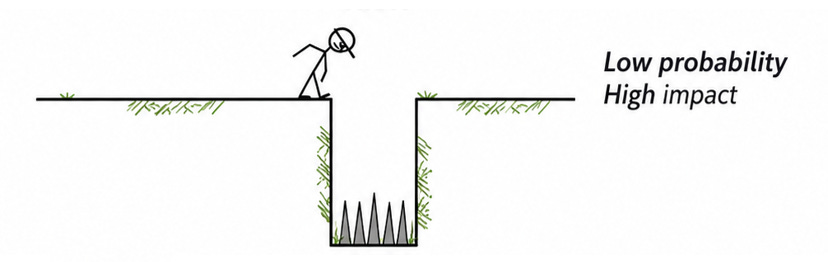
Examples include:
Not wearing a seat belt while driving on the highway
Not buying term insurance when the family depends on your income
Standing as a guarantor for someone else’s large loan
Keeping most of your net worth in the RSUs of the company you work for
A low-probability event is not automatically a low-risk event.
The event may have a low probability. But if it happens, the damage can be enormous or even irreversible.
When the possible impact is devastating, we must protect ourselves even if the event appears unlikely.
The father of one of my friends lost a large amount in a trading scam.
He first invested a small amount and got his money back. He repeated it a few times, and every time the money came back properly. Naturally, his trust kept increasing.
Once he became confident, he invested a much larger amount.
That was the time the money never came back.
To him, the probability of losing money looked very low because he had successfully received his money several times. The actual risk may have been much higher. But his past experience made it look safe.
Therefore, when the probability of something going wrong appears very low, do not stop the analysis there.
Ask the second question:
“If this unlikely event actually happens, can I survive the damage?”
If the answer is no, you must protect yourself even if the probability appears tiny.
This is why we wear seat belts, buy term insurance, diversify large RSU holdings and avoid becoming guarantors for loans we cannot personally repay.
You do not protect yourself because the event will definitely happen. You protect yourself because you cannot afford the consequences if it does.
Situation 4: High Probability, High Impact
This is the most dangerous combination.
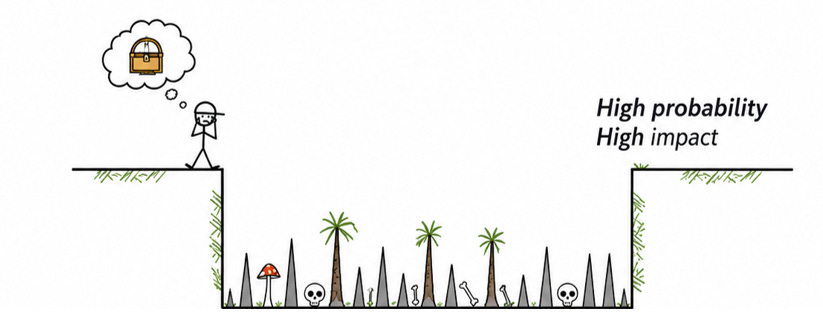
The event has a meaningful chance of happening and if it happens, the damage will also be substantial.
Examples include:
Keeping your life savings in a weak cooperative bank merely to earn slightly higher interest
Driving after drinking
Investing money required for your child’s education after two years into a very speculative property
Putting most of your net worth into an unregulated investment scheme
Taking a massive loan when your income is already unstable
In such situations, both the probability and the impact are high.
People often take such risks when they desperately want to make money quickly. But even wealthy and educated people make these mistakes. When greed takes over, qualifications don’t always help.
These are generally the risks we should avoid or reduce significantly before proceeding.
The paradox of “High Risk High Return”
Whenever we invest in a risky product, we must pay equal attention to both parts of the statement:
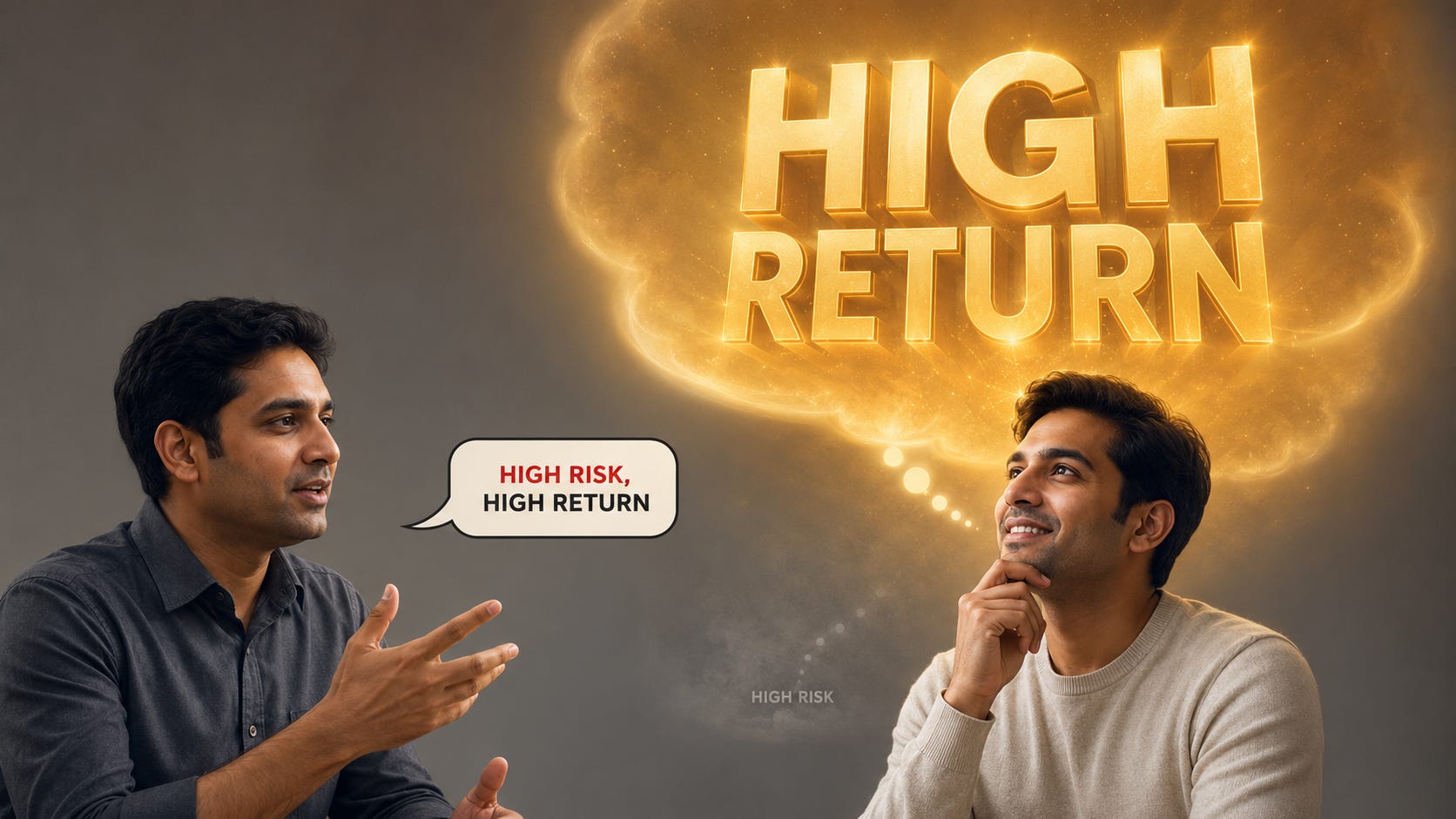
HIGH RISK. HIGH RETURN.
But our mind does something very interesting.
It enlarges the words HIGH RETURN and almost makes HIGH RISK disappear.
Most people focus too much on the “high return” part as if the return is guaranteed and receiving it is their right. At the same time, they treat the “high risk” part as a formality, something written only because regulations require it.
But risk is not a formality.
Sometimes, it actually happens.
When you invest in an under-construction property sold to you as a “game changer,” and the project later gets stuck in a legal battle, remember that you focused mainly on the possible return. You never seriously asked what “high risk” could look like. The legal battle, delayed possession and blocked capital were always among the possible outcomes. You noticed the reward but never properly read the rules of the game.
When you leave a stable job and join a startup for a higher package, faster learning and better growth, do not be completely shocked if the startup eventually fails and you lose your job. That possibility was always present. You simply gave far more importance to the upside than to the downside.
When you invest ₹20 lakh in a restaurant with a friend, you imagine a successful outlet, multiple branches and regular passive income. But business failure, additional capital requirements, disputes between partners and complete loss of money were also part of the original deal. You cannot accept the possibility of becoming a crorepati while mentally rejecting the possibility of losing ₹20 lakh.
Of course, I am not saying that fraud or mis-selling should be excused.
If someone deliberately hid important facts or made false promises, you were genuinely cheated. But every disappointing outcome is not cheating.
Sometimes, the risk you willingly accepted simply materialised.
“High risk, high return” does not mean that taking higher risk guarantees higher returns. It only means that the possibility of earning more comes with the possibility of losing more or getting a very different outcome from what you expected.
When you choose a high-risk investment, you are accepting two possibilities:
The high return may happen.
The risk event may also happen.
You cannot mentally sign up only for the first possibility.
High risk does not guarantee high returns. It only creates the possibility of high returns. Sometimes the return arrives, and sometimes the risk does. Both were part of the deal.
What Does Risk Have to Do With Financial Freedom?
A lot.
You cannot achieve financial freedom without taking some risk. If you keep all your long-term money in savings accounts and low-return products, inflation itself may push your financial freedom further away.
But taking too much risk can be equally dangerous. You may spend 15–20 years building wealth and lose a large part of it because of one concentrated investment, excessive debt, an unregulated scheme or a business decision whose downside you never properly understood.
Financial freedom is not about earning the highest possible return. It is about taking enough risk to grow your wealth, without taking a risk that can destroy years of progress.
Your ability to take risk also changes with time.
Losing ₹5 lakh at the age of 28 may be painful, but you still have many years to recover.
Losing ₹2 crore at the age of 55 can completely disturb your retirement, even if you have a much bigger corpus.
So, before taking any major risk, ask yourself:
If this goes wrong, will my financial freedom get delayed by six months or by ten years?
Take the risks that help you move towards financial freedom. But stay away from risks that can take that freedom away from you.
Ready to Begin Your Financial Freedom Journey?
If Financial Freedom is an important goal for you and you would like some guidance, support and accountability along the way, you can explore our #missionFIRE project.
Next Steps
Read stories from our clients as they share their Financial Freedom journeys and important milestones.
Take our 25 questions Financial Health Checkup
Contact our team to learn more about the program and how it works.